Open at the core
Architecting industrial edge systems for determinism, modularity, and long-term lifecycle management
When I began working on industrial edge software more than a decade ago, the technical challenge was never simply connecting devices to the cloud. At that time, security, updates, and privacy were rarely treated as architectural priorities. Many deployments used minimal or outdated encryption mechanisms, and the industry was only beginning the transition from microcontroller-based systems to more capable microprocessor platforms. The real challenge was designing systems that could survive in production for fifteen years, interface with unpredictable field hardware, evolve without downtime, and reliably work where failure has operational consequences.
Over time, both at Eurotech and as Project Lead of Eclipse Kura at the Eclipse Foundation, I have seen one architectural principle consistently prove itself: if your edge system is not modular, open, and security-first from day one, it will eventually become fragile under scale.
This mindset ultimately shaped what we describe today as enterprise-grade edge AIoT: open-source native, secure by design, and commercially supported. This has evolved into a key design requirement.

Industrial edge is not the cloud
Industrial IoT environments operate under constraints that differ significantly from those of typical cloud-native systems. An edge node deployed in a factory, railway vehicle, or energy substation is not a stateless container running in a managed cluster. It interacts with serial buses, industrial protocols, proprietary PLCs, and hardware interfaces that were often designed decades ago. It must process data deterministically, tolerate intermittent connectivity, and continue operating even when upstream systems are unavailable, most of the time in demanding environmental conditions.
In many deployments, edge systems are geographically dispersed and not always physically accessible. They may operate in environments where no operator is available to intervene, reboot the device, or recover credentials if something goes wrong. These systems can also be more exposed to physical tampering, which makes resilience and built-in security mechanisms even more critical.
Why runtime modularity still matters
Eclipse Kura was built on top of Java and OSGi precisely because runtime modularity is not optional in industrial systems. OSGi provides dynamic service registration, lifecycle management, and component isolation that allow services to be installed, updated, or restarted independently.
In the cloud, restarting a service is trivial. In an industrial plant, rebooting a gateway can interrupt data acquisition and disrupt field communication. Edge systems are often geographically dispersed, not always reachable in real-time, and may lack on-site operators to intervene if something goes wrong. They can also be more exposed to physical tampering.
For these reasons, updating a protocol adapter, patching a security module, or deploying a new inference service without rebooting is not just convenient; it’s essential for reliable and secure edge operations.
When Eurotech contributed to the initial Eclipse Kura codebase to the Eclipse Foundation, the intention was to create a transparent, extensible edge framework that developers could inspect, adapt, and build upon. Later, Eclipse Kapua extended these principles to device management and integration platforms, enabling secure orchestration across fleets of gateways.
At Eurotech, these open components form the foundation of the Everyware Software Framework (ESF) at the edge and Everyware Cloud (EC) for orchestration and integration. The open-source core remains visible and auditable, while the enterprise layer adds an extensive set of field protocols (not available in open source), hardening, validation, compliance alignment, and long-term support commitments.

Integrating AI as a first-class runtime citizen
Edge AI introduces additional complexity that many architectures underestimate. Deploying inference models at the edge requires predictable resource management, controlled lifecycle handling, secure update mechanisms, and compatibility governance across a world of heterogeneous assets.
In a properly designed edge runtime, inference modules are modular services managed by the same lifecycle mechanisms as protocol handlers or connectivity services. This ensures that AI workloads are subject to version control, controlled deployment, rollback capabilities, and remote management.
This is what we mean by enterprise-grade edge AIoT. It is not about experimentation at the edge; it is about embedding AI into a structured runtime that respects operational constraints.
Secure by design
In industrial environments, security cannot be layered on top as an afterthought. It must be embedded into the architecture from the start. Secure-boot hardened operating systems, encrypted communication channels, and certificate-based authentication are essential components, but they must operate within a modular runtime that enforces strict separation between services and controlled interactions.
This approach becomes even more critical when AI capabilities are introduced at the edge. For many innovative companies, AI models represent some of their most valuable intellectual property. Running AI locally at the edge reduces latency, saves bandwidth, and ensures operational autonomy, but it also means these models must be protected throughout their entire lifecycle: from deployment to execution. Protecting them requires a layered security approach, where multiple defensive mechanisms work together so that if one layer is bypassed, additional layers continue to safeguard the system and its assets.
By combining hardware-level trust anchors, hardened Linux distributions, modular middleware, and secure cloud integration, it is possible to build systems that are secure by design rather than secure by patch. Security must be engineered as a continuous chain of trust (Zero-Trust principle) that extends from hardware to applications and data.
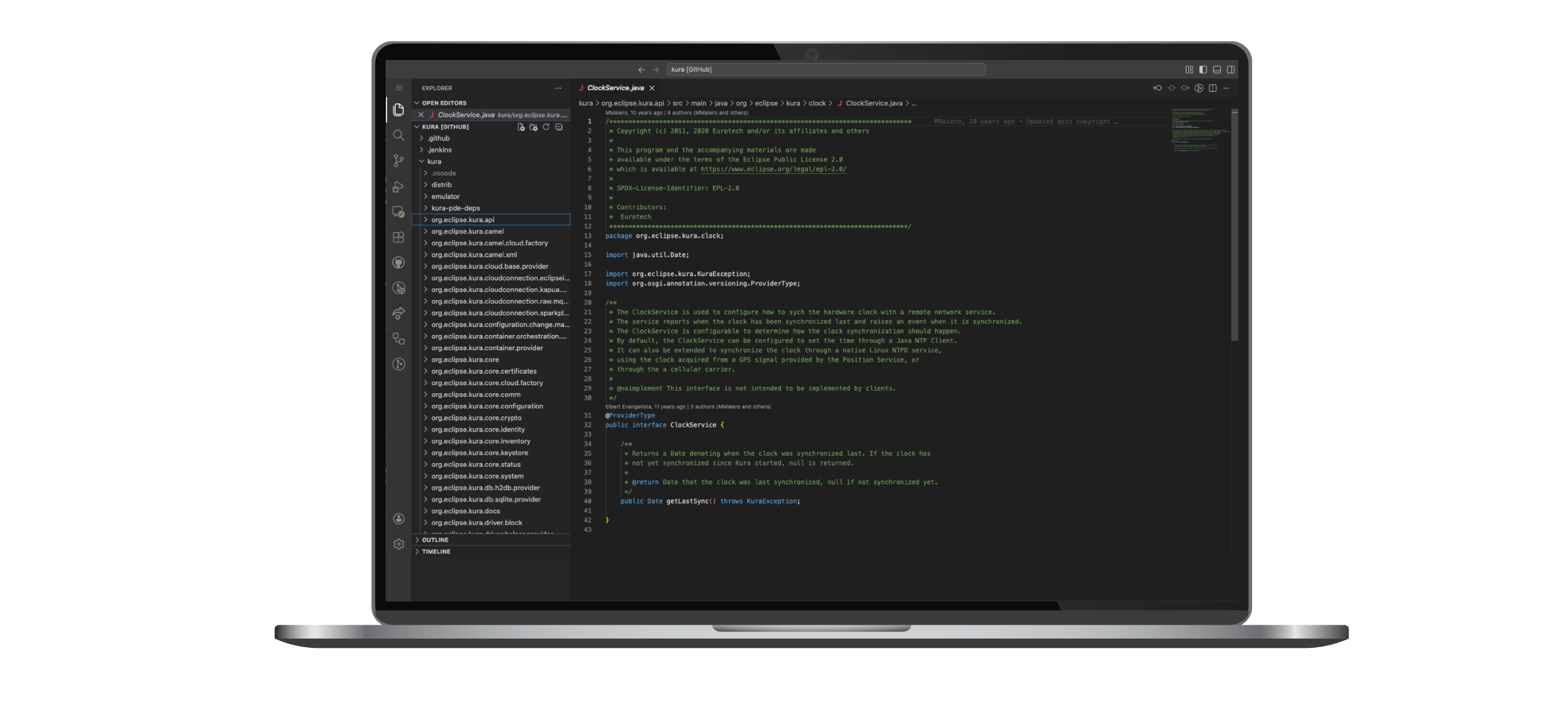
Standards also play a critical role in ensuring that these architectures meet industrial security requirements. The IEC 62443 framework provides a comprehensive model for securing industrial automation and control systems through a defense-in-depth approach. Building on the open-source foundation of Eclipse Kura and extending it with enterprise-grade capabilities in Eurotech’s Everyware Software Framework (ESF), it has been possible to implement the controls and lifecycle management required by this standard. As a result, Eurotech was able to certify a programmable gateway (including OS and application framework) IEC 62443-4-2 as early as 2021, demonstrating that open, modular platforms can meet very demanding industrial cybersecurity requirements.
Enterprise-grade edge AIoT therefore means more than simply adopting open technologies. It requires combining community-driven innovation with disciplined engineering practices, rigorous validation processes, and long-term lifecycle guarantees. Only in this way industrial architectures can evolve over a decade or more without collapsing under their own complexity.
The future of industrial digital transformation will be distributed, modular, open, and AI-enabled. If designed carefully, it will remain open at its core while being robust enough to carry the weight of real-world industrial operations.